---
title: Do you lead the way you were led?
description: Most leaders copy the leadership style they experienced, without realising it. Discover how inherited habits quietly cost you team performance, and what to do differently.
image: https://yvonnejohnston.co.za/hubfs/Article%2016%20lead%20as%20you%20were%20led-1.png
---
[Skip to main content](https://yvonnejohnston.co.za/leading-forward-blog/do-you-lead-the-way-you-were-led#main-content)
[](https://yvonnejohnston.co.za/)
[Home](https://yvonnejohnston.co.za/) [About](https://yvonnejohnston.co.za/about)
Services ▼
[Leadership Coaching](https://yvonnejohnston.co.za/leadership-coaching) [Individual Coaching](https://yvonnejohnston.co.za/individual-coaching)
[Blog](https://yvonnejohnston.co.za/leading-forward-blog) [Gallery](https://yvonnejohnston.co.za/yvonne-johnston-a-legacy-in-images) [Free Resources](https://yvonnejohnston.co.za/free-resources) [Contact](https://yvonnejohnston.co.za/contact)
[Let's Talk](https://yvonnejohnston.co.za/contact)
[Home](https://yvonnejohnston.co.za/) [About](https://yvonnejohnston.co.za/about) Services [Leadership Coaching](https://yvonnejohnston.co.za/leadership-coaching) [Individual Coaching](https://yvonnejohnston.co.za/individual-coaching) [Blog](https://yvonnejohnston.co.za/leading-forward-blog) [Gallery](https://yvonnejohnston.co.za/yvonne-johnston-a-legacy-in-images) [Free Resources](https://yvonnejohnston.co.za/free-resources) [Contact](https://yvonnejohnston.co.za/contact) [Let's Talk](https://yvonnejohnston.co.za/contact)
self-mastery
# Do you lead the way you were led?
May 06, 2026
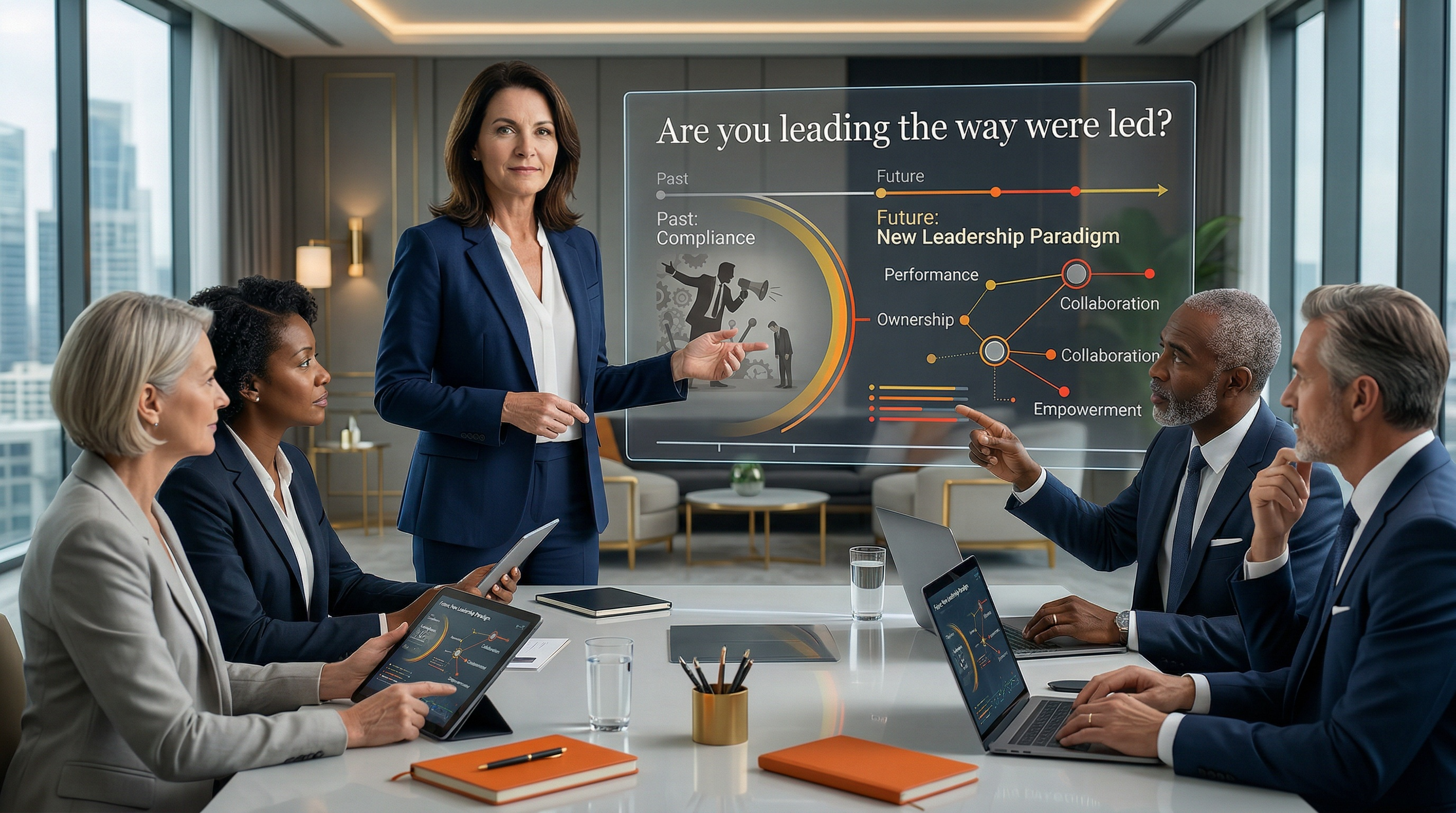
Here's something I want you to sit with for a second.
Think about your last tough week at work. Did you find yourself doing most of the talking in meetings? Did you take a decision back because it wasn't moving fast enough? Did you feel that itch, that pull, to just sort it yourself?
I see this constantly, and I get it. It *feels* like leadership. It feels like you're holding the standard, and that matters.
But honestly? It's probably one of the most expensive habits in your business. And most leaders don't even know they're doing it.
Where does it come from?
Here's the thing, most of us were never actually *taught* to lead. We were taught to perform, to deliver, to hit targets. And the leaders who shaped us? A lot of them led through pressure, force of personality, having all the answers, running a tight ship.
And it worked, so we have just copied it.
Now, when things get hard, that old model shows up. Not because you've consciously decided to micromanage, but because your nervous system defaults to what it knows. You talk more, you push harder, you tighten your grip and feel the need to control.
This has become your pattern through repetition, and almost every leader I work with carries some version of it.
What it's quietly costing you
The short-term cost is sneaky. Compliance *looks* like alignment. A quiet room *looks* like agreement. People executing your call *looks* like trust.
But zoom out a bit.
Over time, your team stops bringing you their thinking, because they've learned you'll override it anyway. They stop owning outcomes, because real ownership requires the freedom to get things wrong. They start working *around* you. Not against you. Around you, because it's faster and safer.
You become the bottleneck without ever meaning to be one.
And the more your business depends on your presence, your energy, your decisions, the more fragile everything becomes. One tough quarter, 0one period of burnout, one holiday where you genuinely cannot switch off. And the cracks begin to show.
The belief underneath the behaviour
Here's what I've noticed. The problem isn't the behaviour itself, it's the belief driving it.
*"If I'm not the strongest voice in the room, standards will slip."*
I understand why that belief feels true. Especially if you've seen what absent leadership actually looks like. But it confuses presence with control. It assumes your team can't hold the standard unless you're holding it for them.
As long as that belief goes unchallenged, the cycle just keeps going. You press, they comply, nothing really changes, you press harder.
What actually shifts things?
This isn't about becoming a softer leader, or stepping back from excellence. It's about recognising that your job has changed. You're no longer supposed to be the best thinker in the room; you're supposed to build a room full of good thinkers.
That requires a different kind of presence. One that asks more than it tells. One that can sit with imperfect and silence for long enough that people actually learn. One that holds people to outcomes, not methods.
This is my soapbox, honestly, accountability. Real accountability. Not the kind where you take the wheel the second things look wobbly.
It's harder than it sounds, especially when the pressure's on and the old pattern is right there, fast and familiar. But it's learnable. And the leaders I work with who make this shift consistently say the same thing: less exhaustion, more delivery, and a team that finally *feels* like a team.
The question worth sitting with
Think about the leader who had the most influence on how you lead today. How did they handle pressure? How did they make decisions? How did they respond when things went wrong? Did their style bring out the best in you, or did it create habits you're still unpicking?
Now look at your last difficult week. How much of that old model showed up in you?
*Do you lead the way you were led?*
If the answer makes you a little uncomfortable, good. That's exactly where the work starts.
A few questions to take with you:
When you step in and take control, what are you most afraid will happen if you don't?
What would your team actually be capable of if you trusted them with the outcome, not just the method?
Which belief about leadership are you ready to retire?
What would leading differently look like for you this week, specifically?

Yvonne Johnston
Leadership & Self-Mastery Coach
Yvonne Johnston is a Master Coach, former CEO of Brand South Africa, and Harvard speaker with over 40 years of leadership experience. She works with senior executives and individuals ready to get clear and make change that sticks.
[LinkedIn](https://www.linkedin.com/in/yvonne-johnston-5581799/) [Instagram](https://www.instagram.com/yvonnejohnstoncoach/) [Work With Me →](https://yvonnejohnston.co.za/contact)
## Keep Reading
### [.png) Why people come to coaching (and why it may not be what you think) June 29, 2026](https://yvonnejohnston.co.za/leading-forward-blog/why-people-come-to-coaching-and-why-it-may-not-be-what-you-think)
### [ "How do YOU think you have done?" June 21, 2026](https://yvonnejohnston.co.za/leading-forward-blog/how-do-you-think-you-have-done)
### [ "We all suffer a little, rather than some suffer a lot" June 08, 2026](https://yvonnejohnston.co.za/leading-forward-blog/we-all-suffer-a-little-rather-than-some-suffer-a-lot)
## Enjoyed This? Get More.
Subscribe for occasional insights on leadership, growth, and intentional living.
No spam. Unsubscribe anytime.
[← Back to All Posts](https://yvonnejohnston.co.za/leading-forward-blog)
## Ready to Move Forward?
Whether you're navigating leadership challenges or personal transformation, let's have a conversation.
[Get in Touch →](https://yvonnejohnston.co.za/contact)
[Yvonne Johnston](https://yvonnejohnston.co.za/) Fast Forward Coaching
Supporting people in moving their lives and businesses forward. Leadership & Self-Mastery Coaching for those ready to change.
#### Explore
[Home](https://yvonnejohnston.co.za/) [About](https://yvonnejohnston.co.za/about) [Leadership Coaching](https://yvonnejohnston.co.za/leadership-coaching) [Individual Coaching](https://yvonnejohnston.co.za/individual-coaching) [Blog](https://yvonnejohnston.co.za/leading-forward-blog) [Gallery](https://yvonnejohnston.co.za/yvonne-johnston-a-legacy-in-images) [Free Resources](https://yvonnejohnston.co.za/free-resources) [Contact](https://yvonnejohnston.co.za/contact)
#### Get in Touch
[yvonne@yvonnejohnston.co.za](mailto:yvonne@yvonnejohnston.co.za) [+27 83 327 1790](tel:+27833271790) [+34 666 35 96 19](tel:+34666359619) South Africa (Coaching via Zoom worldwide)
#### Follow Along
© 2026 Yvonne Johnston. All rights reserved.
[Privacy Policy](https://yvonnejohnston.co.za/privacy) | [Terms of Service](https://yvonnejohnston.co.za/terms) | [Cookie Policy](https://yvonnejohnston.co.za/cookie-policy)
```json
{
"@context" : "https://schema.org",
"@type" : "BlogPosting",
"author" : {
"@type" : "Person",
"name" : "Yvonne Johnston",
"url" : "https://yvonnejohnston.co.za/leading-forward-blog/author/yvonne-johnston"
},
"dateModified" : "2026-05-06T17:17:46.139Z",
"datePublished" : "2026-05-06T17:17:33.000Z",
"headline" : "Do you lead the way you were led?",
"image" : [ "https://yvonnejohnston.co.za/hubfs/Article%2016%20lead%20as%20you%20were%20led-1.png" ],
"mainEntityOfPage" : {
"@id" : "https://yvonnejohnston.co.za/leading-forward-blog/do-you-lead-the-way-you-were-led",
"@type" : "WebPage"
},
"publisher" : {
"@type" : "Organization",
"logo" : {
"@type" : "ImageObject"
}
}
}
```